She calls herself a weychafe — a defender of life. Moira Millán is a Mapuche writer, screenwriter, and activist from the Wallmapu (Patagonia), and one of the most urgent voices emerging from Abya Yala today. Her book Terricidio: Sabiduría ancestral para un mundo alterNATIVO (Terricide: Ancestral wisdom for an alterNATIVE world) — now translated into Portuguese, French, and English — has traveled further than most political manifestos, landing in living rooms, university classrooms, and community assemblies across four continents. The concept at its heart is deceptively simple and devastatingly true: that the destruction of the earth and the destruction of peoples are not separate crises — they are one.
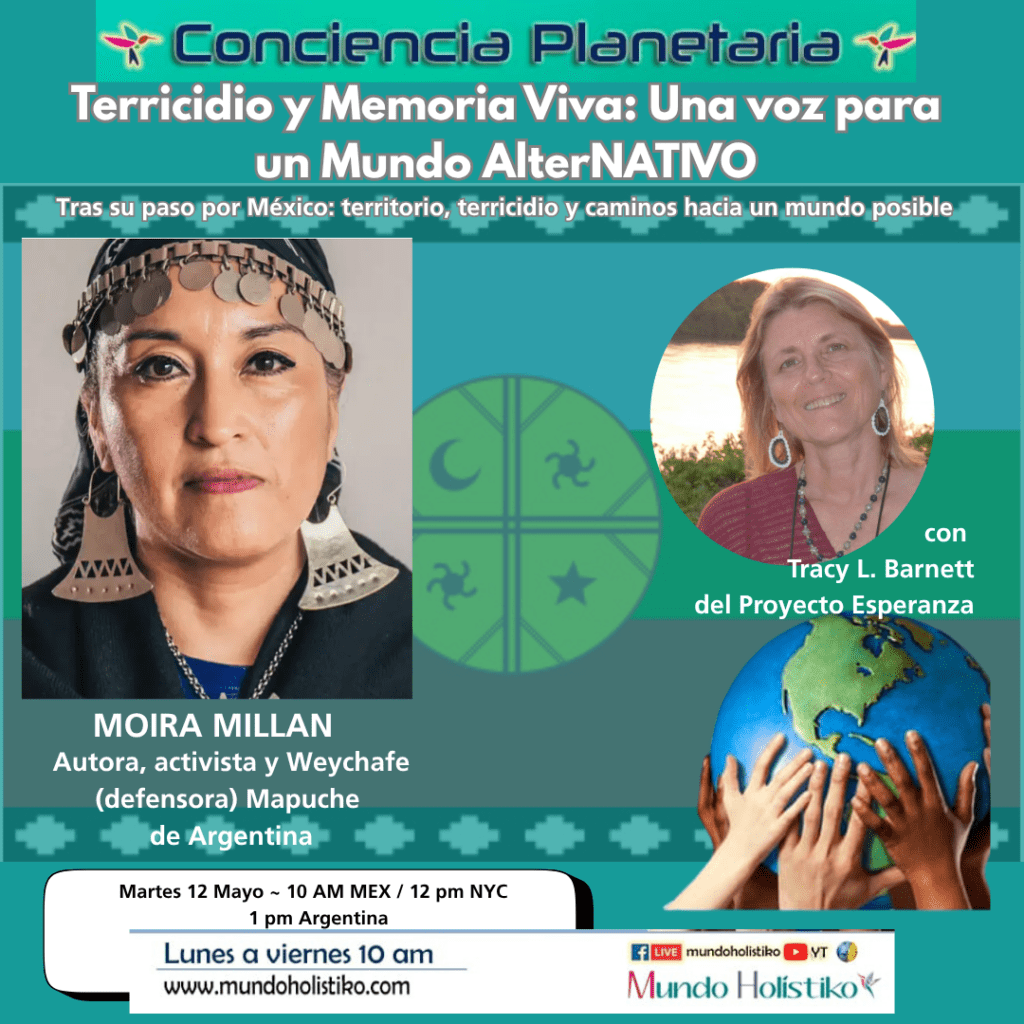
We spoke with Moira during a period of particular intensity in her life: she had just returned from Mexico for the launch of Terricidio’s latest edition and was about to travel again, this time to accompany a Mapuche sister, Soledad Cayunao, who is alone in her fight to defend the headwaters of the Chubut River after they were sold — illegally, she insists — to a foreign buyer. The conversation ranged from ancestral spirituality to colonial violence, from political literacy to the role of books in a poor girl’s life. What follows has been edited for length and clarity.
Tracy:
Let’s start at the beginning — with who you are. You identify as a weychafe. For readers who aren’t familiar, what does that mean?
Moira:
A weychafe is a defender of life. It’s a person inhabited by a telluric, ancestral spirit that gives them access to information — information that arrives through the peuma, through dreams that are premonitory, that show where the struggle will be and how to face it. A weychafe also receives teaching and preparation through spirituality, through ceremonies conducted by the machis [Mapuche healers].
And you are not made a weychafe. You are born one. Just as one is born with the spirit of the lonco [leader] or the spirit of a machi — each person carries certain spirits. We say cuerpo-territorio — body-territory — because territories inhabit bodies and we inhabit territories. There is reciprocity. I went to serve with a machi and there I understood what I was. They performed a ceremony to strengthen my spirit. And for as long as my ancestors determine it, I will keep helping in the struggle.
We are not warriors in the martial sense. We are defenders. Defenders of life, willing to protect our territories and our people.
Tracy:
Your path to this identity wasn’t straightforward. You grew up in the city, far from your ancestral lands. How did you find your way back to the land, and to your traditions?
Moira:
Yes, and the call of the Earth doesn’t come gently. It comes as sadness, as anguish, as desolation. A feeling that you are not in the right place, that there is a purpose you cannot yet see but that lives inside you and makes you want to leave the city, to find the mountains, to find the ancestral territory of your people.
It happened to me at eighteen. I went to my father’s community, met my uncles and cousins, and there I understood what had been torn from us. At first I embraced my Mapuche identity through spirituality. And then I understood that to keep that spirituality alive, we had to defend the identity of the territories. One follows from the other.
Tracy:
Your book Terricidio has now been translated into multiple languages. Can you explain the concept for someone encountering it for the first time?
Moira:
Terricidio — terricide — refers to all the ways the current system attacks life. But more than that, it names the interconnection between all forms of life and all expressions of living. When an element of nature disappears, an element of culture disappears with it. Attacks on diverse bodies are also attacks on the diversity of ecosystems. When genocide is committed, when feminicide is committed, terracide is being committed.
The terms we already have — ecocide, genocide, feminicide — are important. But they each emphasize the elimination of specific sectors without naming the interrelationship between them. Terricide says: all lives are intertwined. Therefore the struggle against terracide must be addressed from a comprehensive, relational perspective, in articulation between all sectors.
And I always speak in the plural, because Terricidio is not the product of a single brilliant mind. It is the theorization of collective practices — a gathering of voices, experiences, paths that indigenous peoples have been walking. I am the collector, not the sole author.
Tracy:
The book also carries a subtitle — Ancestral Wisdom for an Alternative World. In a moment of such deep civilizatory crisis, where does that alternative actually come from?
Moira:
We are living through a level of aggression against peoples and against the Earth that we have never seen before — a perverse fascism in which horror seems to be state policy, in which crimes pass with total impunity. And faced with this, there is a widespread despair, a resignation. People feel there is no way out.
But we believe the alternative lives in the ancestral wisdom of the peoples. These are times to ask: what is evolution, really? What is development? We need a paradigm in which the Earth is understood as a subject and a protagonist — and I have no doubt that this is what is happening. The earth itself is setting the agenda for the defense of life. We no longer wait for leaders, for formulas, for vanguard parties. The earth is the one shaking us and demanding a response. And in that sense, we believe in a different world — one that the peoples have been building for thousands of years, and whose postulates have never been more urgent.
Tracy:
You’ve named chineo as one of the colonial crimes your movement has fought to put on the public agenda. Can you explain what it is?
Moira:
It is a colonial practice that has been sustained throughout the entire history of this country — and probably others as well. Criolla men with economic power created a verb, chinear, which means to choose indigenous children to rape. They experience it as an initiatory rite. They go to families and give them payments, as if they have become owners of the children they have violated. But the children live it in desperation — some take their own lives, some are made to become mothers.
There are generations and generations of women and girls who have been violated. And when they try to report it, Argentine justice tells them the perpetrators cannot be judged because it is “cultural.” We say: yes, it is a cultural inheritance — a criminal one, from colonialism — and it must be judged. With severe penalties.
Chineo cannot be characterized simply as gang rape, because it is not a random attack. These are men who go deliberately into indigenous territory, who know they are entering indigenous territory, who choose indigenous victims, and who have an entire power structure protecting their impunity. There is a racist and colonial dimension that must be named explicitly and weighted in any sentence.
One province, Salta, has recently moved toward legislating against chineo. But the law strips out the racist dimension that we insisted must be included. They named it after an indigenous woman who lived in those lands — and then emptied it of the justice we were demanding. We spoke of healing justice. They speak of reparation. What has been done is irreparable. You cannot repair it.
Tracy:
Your native territory of Wallmapu — Patagonia in Spanish — has seen devastating fires two years running. What is actually happening there?
Moira:
Two plus two equals four. The fires come. And after the fires come the reforms: the glacier law, the land law — now changed to allow the sale and privatization of burned land that was previously protected from sale, precisely to discourage arson. Then comes the announcement that 300,000 Israelis will be received as refugees. Then the militarization of the territories — and few people know this because of the media blackout, but a military arsenal purchased from Israel has arrived in Patagonia. Modern tanks, arms of all kinds, sent both to Wallmapu and to Tierra del Fuego. We see a war scenario being configured, without any external enemy. So we understand those weapons are meant for us.
And meanwhile, the government insists — without evidence — that Mapuche people are the arsonists. They have video documentation, denunciations with evidence of who is actually setting the fires. But instead of acting on that evidence, they construct a fiction that puts us as the authors.
The fires brought pain and territorial displacement. But they also brought the poetry of unity — communities that came together, that answered the abandonment of the State with solidarity. Even communities that had lost everything and were raided afterward kept standing. That too is part of our history.
Tracy:
The Mapuche people were never defeated by Spain. Many people don’t know that.
Moira:
The Mapuche people defeated two great empires. First the Inca Empire, which was advancing south and encountered the Mapuche people — who defended their territory and won, and the Inca had to leave. Then came the Spanish, who also tried to invade. There were wars, and they ended in treaties and formal agreements in which Spain recognized Mapuche sovereignty over our territories.
What finally invaded us were the nation-states — Argentina and Chile — with programs imported almost directly from the United States. The conquest of the desert in Argentina and the so-called “pacification of the Araucanía” in Chile are copies of the conquest of the American West. These two states carried out genocide because they could not have consolidated themselves without it.
But I feel that we have won in a different sense — they did not exterminate us. We are here. We are recovering our ceremonies, our mapudungún [language], our forms of healing, of giving birth, of educating. We still speak with the river, with the mountain, with the rain, with the forest, with the animals. That, to me, is the reflection of a people that does not surrender.
Tracy:
You’ve also built something — the Pluriversidad on your land. Tell us about it.
Moira:
I donated my home — which I built myself, by hand, with bioconstruction — so that the Pluriversidad (“pluri-” from pluralistic + universidad, or university) project could happen there, at the Lof Mapuche Pillán Mahuiza. It is a space of autonomous education in which different knowledges are put into dialogue. Not only ancestral knowledge, but also knowledges for buen vivir, good living — alternative technologies, bioconstruction, and others that arise from the needs that emerge.
Because we cannot wait for this harmful world to disintegrate before we begin building the alternative. We have to be growing it already, feeling it, living it, strengthening it. So that when this anthropocentric, individualist, hypercapitalist world finally falls apart, there will already be a working draft of the good life. That is what the Pluriversidad tries to do.
Tracy:
You’ve spoken about political illiteracy as one of the conditions that allows all of this to continue. How do we change that?
Moira:
All initiatives are valid — street theater, community radio, popular libraries, dining halls. I always say that I am the product of a soup kitchen. I was a small girl, malnourished, and my mother took me to the doctor, who told her I needed food. I ended up in a popular dining hall for children — and there they taught me to read and write.
Books changed my life. I was a child from an extremely poor neighborhood, a very poor family. My destiny would probably have been otherwise — completely defined by oppression. But books opened my mind. I was able to understand social inequality and rebel against it.
We need to go back to that: nourishing not just the body but the mind. In a time of so much manipulation through screens and algorithmic language that INcommunicates instead of communicating, we need to bring books to children. Let them play, laugh, imagine, fly. Don’t imprison them in screens.
The main objective right now would be to give children the possibility of a better world. Go out and do territorial work, community work, go to the communities, support the defenders of life. Don’t abandon those who are protecting the ecosystems. Bring books to the young. That is the struggle too.
Tracy:
Finally — what sustains you personally? Where do you find the strength and hope to keep going?
Moira:
In the Mapu. In the Earth.
I find strength and hope in the Earth. I feel that it is full of love, full of wisdom. In some of our most difficult moments — we suffered a raid by a hundred police who entered my house, who beat us, who took members of our community — and I found peace, calm, and strength in the land. When I speak with the river, when I speak with the mountain, with the forest, I feel that my ancestors and the protective forces of that place are watching over me, caring for me, and still in dialogue with us.
The day the Earth stops speaking to us — that is when we should truly despair. But as long as we keep speaking with the Earth, and the Earth listens, there is strength and there is hope.
Moira Millán’s book Terricidio: Sabiduría Ancestral para un mundo alterNATIVO is available in Kindle format through Amazon in Spanish, French and Italian, with an English translation forthcoming; her novel, Train to Oblivion, is found there in English. She is the founder of the Movimiento de Mujeres y Diversidades Indígenas por el Buen Vivir (Movement of Indigenous Women and Diversities for Good Living).
This interview was conducted and translated from the original Spanish by The Esperanza Project.
- Recycling Without Recyclers Is Garbage: A Dispatch From the Heart of Iztapalapa - September 25, 2026
- Clean Air Fair turns Parque Rojo into open-air classroom - September 19, 2026
- Topolobampo: Can Moving the Pipes Protect a Sacred Bay? - August 26, 2026
buen vivir environmental justice Extractivism indigenous peoples indigenous women Mapuche Moira Millán Patagonia terricide Territory Defense