Text and photos by Tracy L. Barnett.
As the sun began to set over the Paseo de los Guardianes de la Reina (Walk of the Queen’s Guardians) in Tonalá, the scent of copal incense hung in the air like a prayer. On the cobblestones, beneath the sculptures of the guardians and with the Cerro de la Reina (Queen’s Hill) looming in the distance, a group of dancers in white manta cloth and red and green sashes arranged a tlamanalli—an altar of flowers, seeds, herbs, and copal placed directly on the earth—on a purple cloth. As they circled the offering, the deep rhythm of the huehuetl drum and the sharp call of the conch shell mingled with the voices of the elders invoking the four cardinal directions. Thus began the inauguration of the first Te Deum Spirituality Expo, a two-day gathering that wove together Catholic vestments and crosses with ancestral deities and sacred elements.
Para leer este artículo en Español haz click AQUÍ

A Call to Unity
Sandi Bell, the woman who dreamed up and organized the expo, watched with tears in her eyes. “It symbolizes our unity,” she explained later, sitting to the side as a chirimía band performed. Bell describes herself as “an instrument of God” and “a spiritual guardian of this sacred and blessed land that is Tonalá,” and conceived the event after three years of prayer and meditation. The juxtaposition of crosses and pre-Hispanic symbols was, she says, a deliberate act of healing.
“It’s no longer about inequality… no more beliefs, but about feeling from love, speaking from love, listening from love, seeing from love…” she explained. “May every being we touch be a blessing in love.” For her, humanity is called to reconnect with its spirit beyond dogmas and divisions: “Our body is a living temple of the Holy Spirit… we are no longer slaves to beliefs but to the freedom of being.”
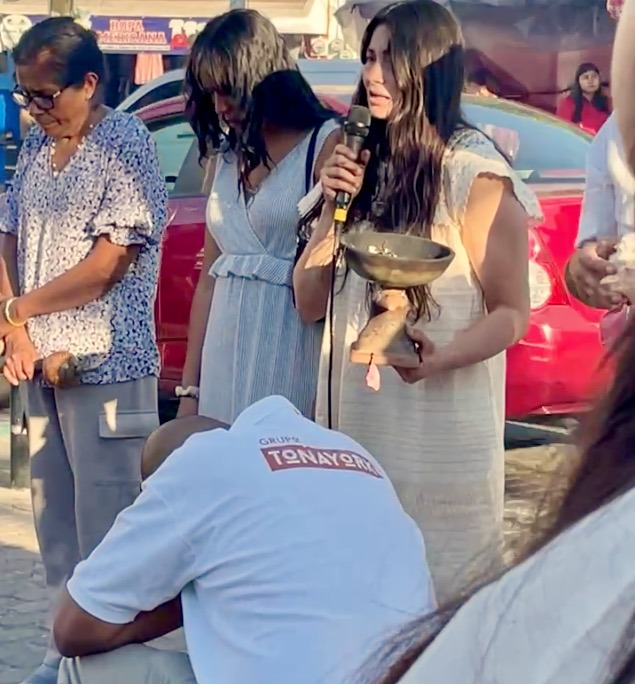
Sandi Bell, organizer of the Expo Te Deum, offered a prayer asking for unity and ancestral guidance, wishing that “what our grandfathers and grandmothers dreamed and walked through introspection and contemplation may become a reality here and now.”
As a sacred copal incense fire keeper, Bell honors fire and what it represents. “Fire represents our roots… strength, the union of the sacred feminine and the sacred masculine, where in duality we are one, where there is no more struggle, no more war,” she said. Hence, the opening ceremony included a call to the four cardinal directions: “We call upon all our guardians, opening the four cardinal directions… Tonalá is already protected, but now they have come to support and unify this sacred land, because we are free.”
Pachamama and Respect for the Earth
Then Yaomitl, a temazcalero from Temazcal Los Colibríes, took the floor, wearing a red bandana on his head. He raised a conch shell to his lips and blew a haunting call.
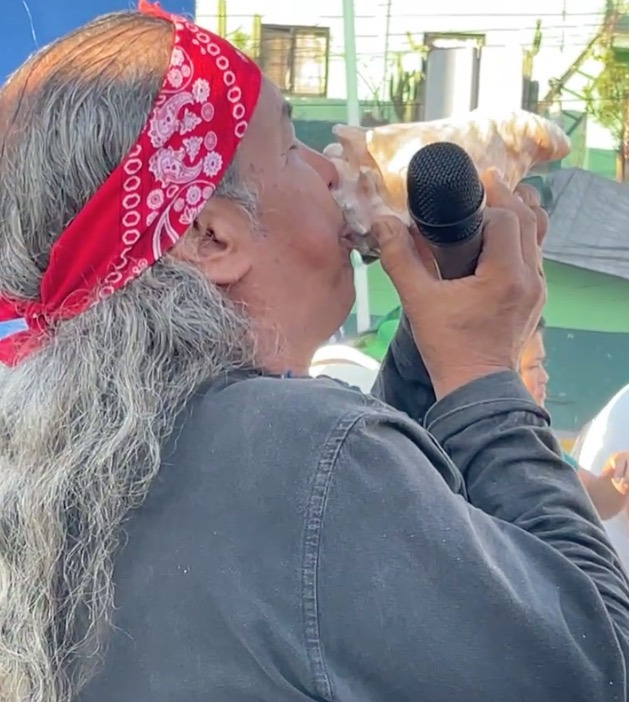
“We bless our Mother Earth, our Pachamama, for we are in her womb,” he said, reminding everyone that their lives depend on the ground they walk on. “Let us become conscious, loving her, caring for her, respecting her… because she is the one who gives us life.” He also reminded them that they do not own the land: “We do not own these lands… our Creator… made them to be shared in love, not in destruction.” And he added a firm commitment: “I reject any project that seeks to frustrate or mistreat… our Mother Earth.”
His words resonated in a community that has been resisting urbanization proposals around Cerro de la Reina for decades. Governments and businesspeople have proposed an amusement park and real estate projects on this sacred hill, and even a cultural project—Yolkan—that intended to dedicate five hectares to a luxury hotel. These proposals have been halted by residents and community groups, but the risk remains. During the expo, however, the atmosphere was one of prayer and harmony; the defense of the territory was manifested in respect for Tonantzintlalli and in prayers.
Wake Up, Tonalá
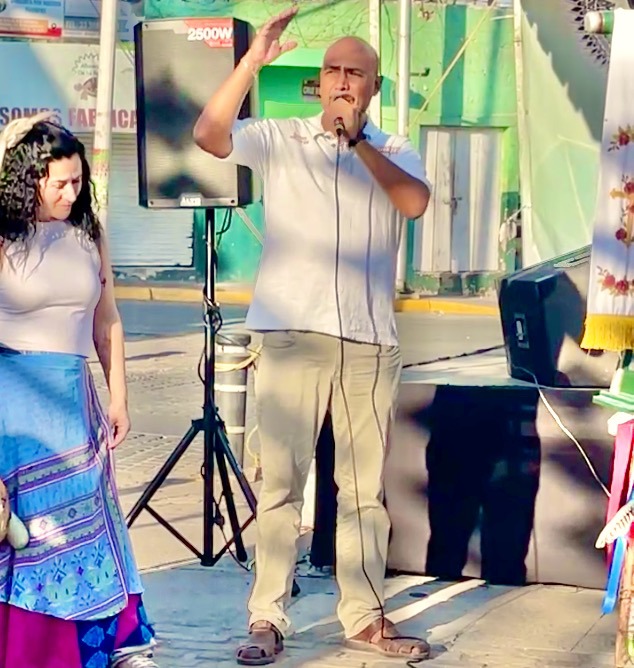
The call to awaken was repeated throughout the day. Alfred Melchor, creator of the Tonayork platform, took the microphone and said: “Wake up, Tonalá… wake up, Tonalá, it’s time.” Melchor, who has documented the beauty of his municipality on social media, recognizes the artistic and cultural potential of his town, but also its challenges. “It’s said that we are the backyard, the ugly duckling of the metropolitan area. Perhaps we are asleep, in the sense of conformity, in the sense of envy,” he commented. “Tonalá is the pottery cradle of all of Mexico… we Tonaltecas were endowed with marvelous ingenuity and imagination,” he added; however, he laments that competition and copying among artisans stifles that creativity.
For him, events like the Expo are essential because “it reminds me of who I am and where I come from… Tonalá is a wonderful place.” He encourages his fellow Tonalá residents to hold their heads high: “You can draw on countless techniques… there’s no need to be copying others,” he affirms. And he summarizes the spirit of the expo: “The event is the sum of hearts, the sum of wills and intentions for a better Tonalá, for a better world.”

Miracles of Community
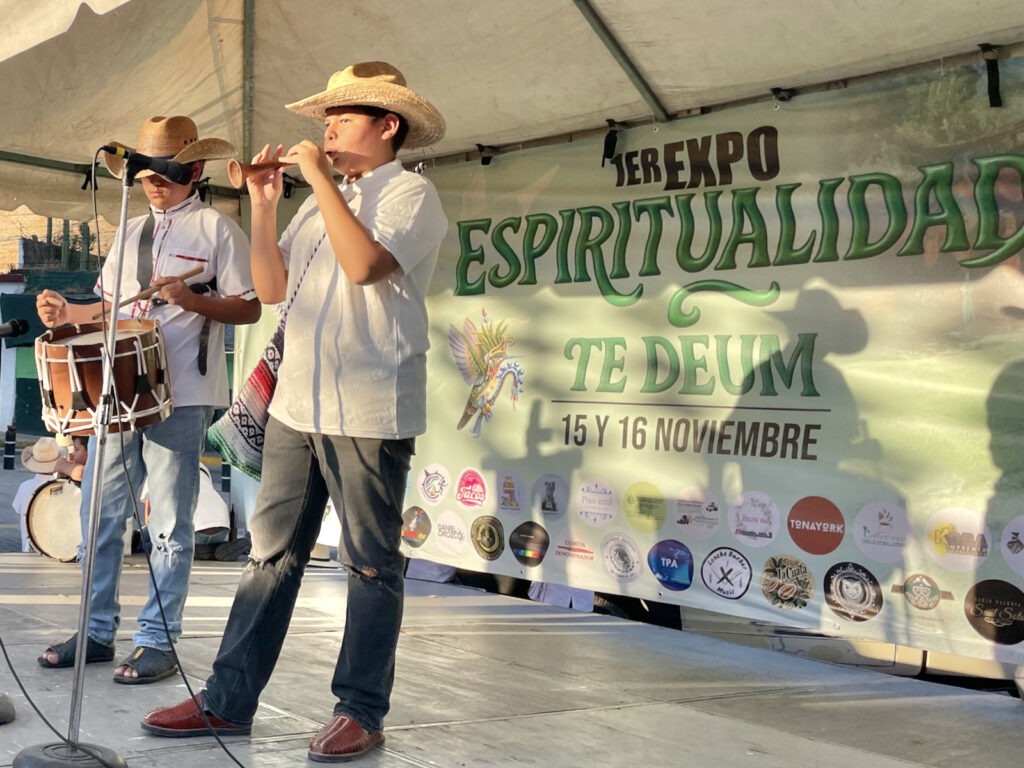
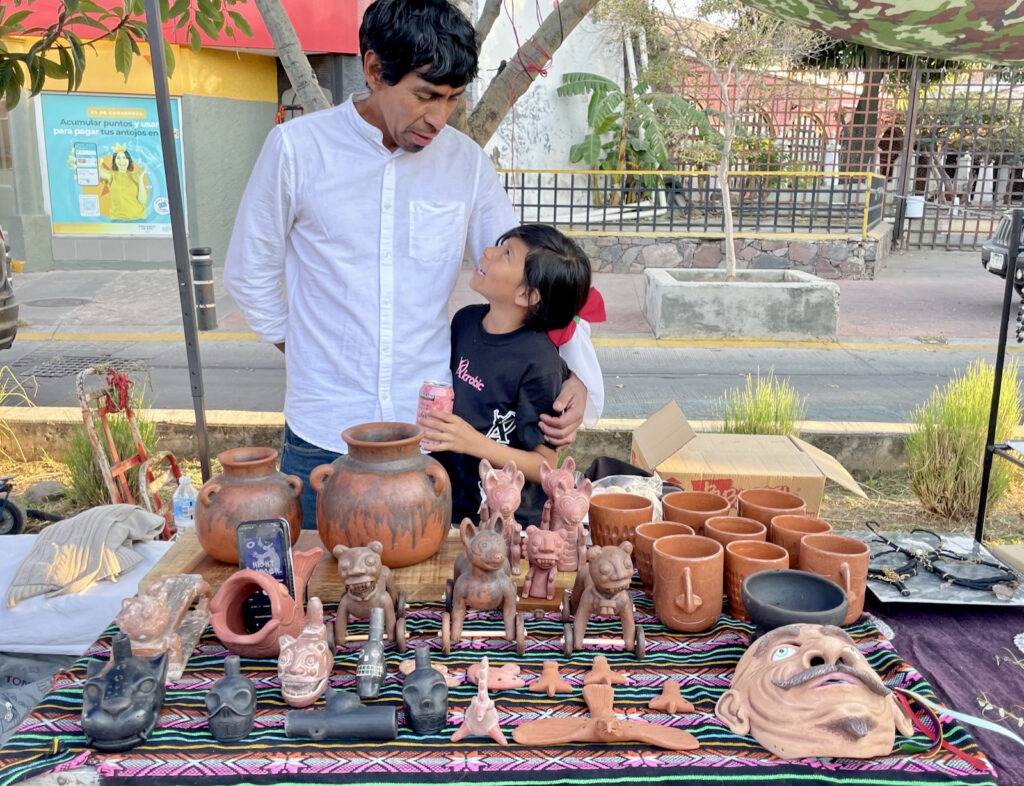
While musicians from the Municipal School of Chirimía—founded by maestro Mariano Medrano to revive this nearly extinct tradition—played their flutes and drums, entire families strolled along the promenade. Juan Jaimes Contreras, a potter, tended his stall filled with clay figures, while his daughter Huitzi asked him questions. The event was intergenerational by design and also by necessity: the organization was financed with small contributions and, Bell says, with miracles.
Bell received no government assistance. Saúl Soto, a sculptor from Tonalá, donated an image of Santiago, the local patron saint, for a raffle. “Fifty tickets were raffled off at 100 pesos each, totaling 5,000 pesos,” she recalled. With that amount, she and the team paid for the sound system for two days—around 3,800 pesos. pesos—and some of the shared food. “This whole event cost about 5,000 or 6,000 pesos,” she added. Other businesses donated water and tarps. Even a stranger, listening to a prayer from his truck, gave her a 50-peso bill; for Bell, it was a sign: “God is touching this event.”
For Bell, the greatest miracle was the solidarity. “I can’t do it alone… but by joining forces in love, everything was possible,” she affirmed. Hence her insistence on supporting the artisans without haggling: “Please don’t haggle… they put their essence, their energy, into each piece.”
Art, Spirit, and Legacy
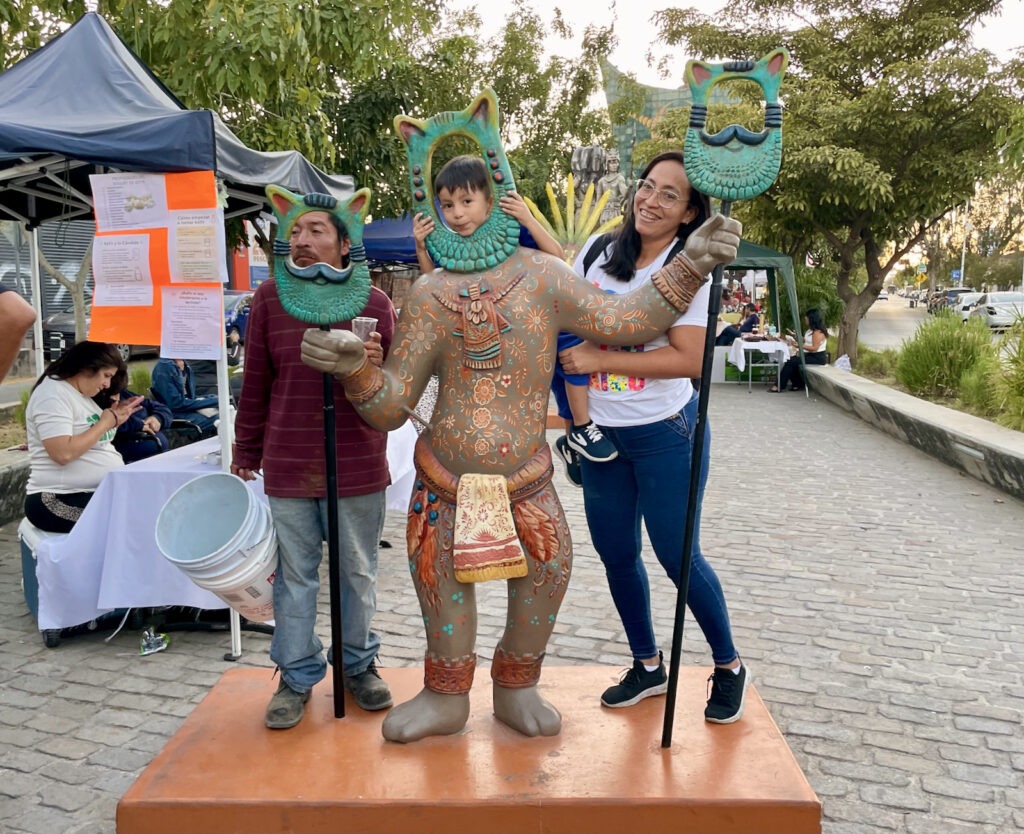
Beyond the prayers, the expo was also a showcase of Tonalá’s artistic heritage. A fair of burnished clay, animal figurines, pots, whistles and masks extended along the promenade. On the stage, crosses decorated with embroidered cloths mingled with figures of snakes and suns. Children took photos among the giant sculptures of guardians, their faces peeking out from behind clay jaguar masks.
For Bell, the relationship between prayer and crafts is natural. Her family comes from a line of artisans, and she sees the act of creating as a form of devotion. She invites healers, herbalists, potters, and weavers not only to sell their wares but also to share their stories. “The freedom of being is our Pachamama,” she repeated. For her, art and prayer are ways of remembering who we are and where we come from.
PHOTO: Grandmother Ana Lucía Chinas, from the Kalpulli Kuetzpalkalli dance circle, prays for the presence of the ancestors and for Tonallan—the pre-colonial name for Tonalá, which in Nahuatl means “the place of dawn”—to be reborn as a Ceremonial center, recalling the knowledge inherited from past generations.
Land, memory, and love. Cerro de la Reina (Queen’s Hill) rises above the municipality, both physically and symbolically. Since the late 19th century, when eight statues of the Tastoanes (the pre-colonial kings) were placed and a chapel dedicated to the Virgin was built, the hill has been a ceremonial center. Today, its ecological and cultural value makes it a sacred space. However, developers and authorities have tried to turn it into an amusement park, real estate projects, and even a hotel, as denounced by the Defendamos el Cerro de la Reina (Defenders of Queen’s Hill) collective. These projects have been halted thanks to the resistance, but the risk remains.
During the expo, no one explicitly mentioned these struggles. Instead, reverence for Tonantzintlalli was expressed in shared silence, in songs, and in the beat of the drum. At the end of the ceremony, one of the grandmothers summarized the essence: “No one is more, no one is less, we are all one.” Sandy Bell closed with an intimate invitation: “Be free… know yourself, listen to yourself… don’t listen to anyone else. I connect with love, with edification, and with peace.”
That day, Tonalá seemed to awaken not through confrontation but through remembrance: remembering its language, its sacred hills, its wise grandmothers, and its hands that mold clay. The expo was not just an event, but a loving gesture toward the land and the community. And as Melchor said, walking among the clay guardians: “You walk around here… and you realize how wonderful it is and the strength that all of us inhabitants have, and the culture and energy that Tonalá possesses.” With every step, the city seems to repeat the message: to awaken is to honor, love, and defend that which gives us life.
- Tonalá awakens: Spirituality Expo revives the sacred legacy - December 11, 2025
- Last Chance to Save Mexico City’s Water Forest - June 1, 2024
- March 8: ‘Identity can never be silenced.’ Misak women fight back in Colombia - March 8, 2024