And then there are stories that follow you home.
There are stories you report, file and move on from.
Topolobampo has become one of those for me.
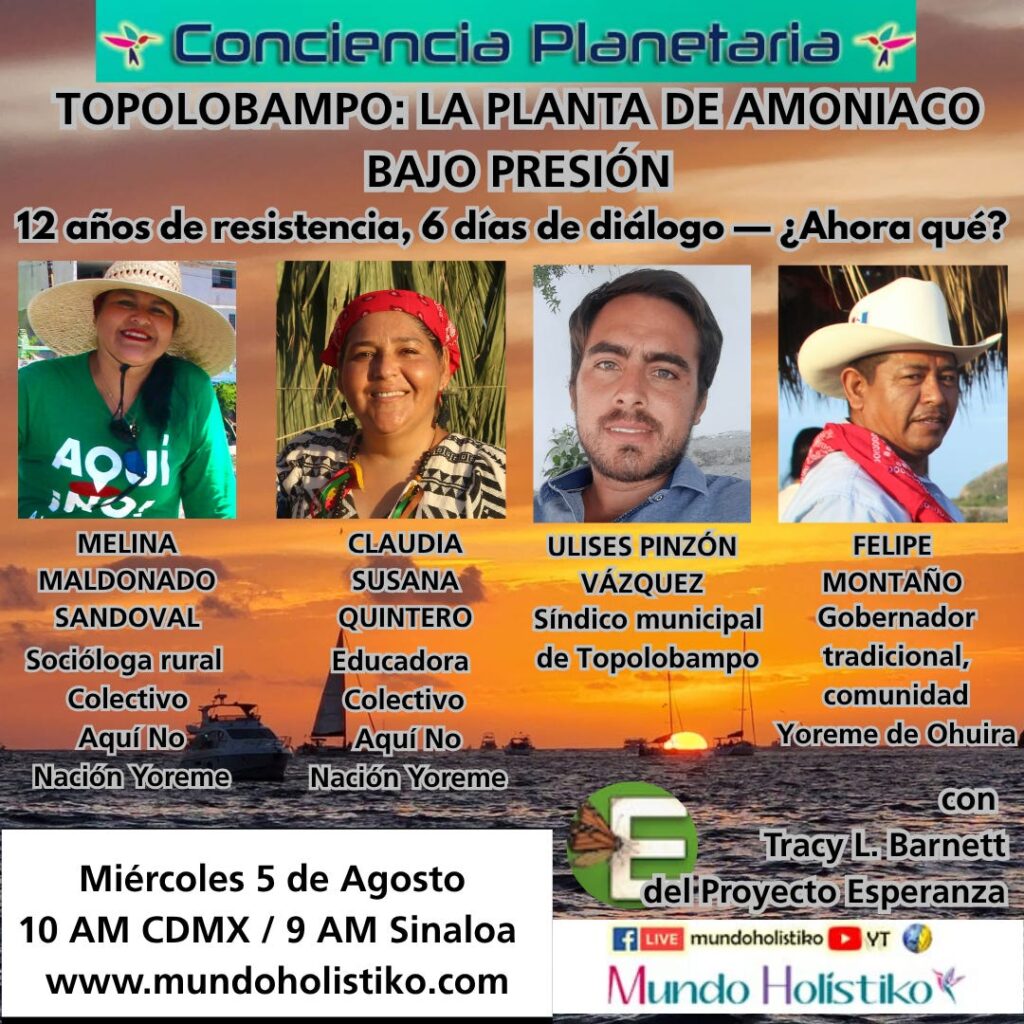
On Wednesday, I interviewed three of the people whose faces you see here—leaders of the Indigenous Yoreme-led resistance to the ammonia plant being built on the shores of Bahía de Ohuira, an internationally protected wetland on Mexico’s Gulf of California.
You can watch that conversation [here]. The interview is in Spanish, but English subtitles are now available—just open the YouTube settings and turn on English captions.
More than once during the interview, they said the same thing:
“Please don’t leave us alone.”
They said it to me personally. And then they said it to everyone watching—to Mexico, and to the world.
Because they are afraid.
And they have reason to be.
Several of them have already received threats and intimidation because of their opposition to the project. Mexico remains one of the most dangerous countries in the world for people defending land and the environment, and also for journalists trying to tell their stories. Sinaloa, meanwhile, is the historic stronghold of one of Mexico’s most powerful cartels, and violence there is hardly new. But the current conflict between rival factions has made an already dangerous place even more volatile.
So when they say “Don’t leave us alone,” they mean it quite literally. Part of it is a plea for visibility—the sense that being seen can offer some measure of protection. But part of it is also a gut instinct as old as danger itself: there is safety in numbers.
So I went to be one more body there. For a week in July I stood with them, sat with them, ate with them, slept beside them.
For more than two months now, these men and women and their allies have maintained a round-the-clock encampment at the gates of the ammonia plant. They have endured temperatures above 100 degrees, torrential rain, violent winds, sleepless nights and the constant uncertainty of what may come next.
What I found there was not fear.
I found irrepressible laughter. A wicked sense of humor. Deep solidarity. A kind of stubborn joy. After 12 years of resistance, these people have learned that if the struggle is going to be part of their lives, then they are going to live it fully — with music, food, jokes, ceremony, friendship and love.
There was also hope. During the days I spent there, before and during the mesas de diálogo, there was a real sense that something might finally be moving. After so many years of being ignored, they were being heard. People were tired, yes, but they were energized too.
I did not feel the fear until later.
In Wednesday’s interview, something felt different. When they said: “Don’t leave us alone” —Not dramatically. Not as a slogan. They meant it.
That was when I understood that beneath the laughter and optimism, there was also a very clear awareness of the danger. And perhaps a growing sense that the moment was becoming more precarious, not less.
Today, as I write this, the government’s proposal is being taken before the people of Paredones, a Yoreme fishing village on Ohuira Bay, for consideration under their traditional system of governance.
It is the second in a series of four community assemblies in Ohuira, Paredones, Lázaro Cárdenas and Topolobampo, where residents will review and deliberate over the proposal before the communities give their answer to the government.
These are not public hearings in the conventional sense. The assemblies are being conducted according to Yoreme usos y costumbres, with restrictions on outside participation, photography and recording, and with the communities themselves holding voice and vote.
In other words, after 12 years of struggle—and after earlier government-run consultations that the communities say failed them—the people most directly affected are now taking the decision into their own hands, exercising their own forms of governance and collective sovereignty. In the week ahead, we will know their decision. But Wednesday’s interview offered a pretty strong spoiler alert. Claudia said it plainly: “Sé que la comunidad nos va a decir que no.” — “I know the community is going to say no.”
Visibility is not a guarantee of safety. But invisibility can be dangerous.
That is part of why I am leaving this image as the cover of my Facebook page for now. I want to see these faces every day. I want to remember to check in, to keep reporting, to keep asking questions—and to keep them in my prayers.
Please join me.
Say a prayer. Light a candle. Send a good thought. Speak their names. Share their story. Whatever solidarity looks like in your own tradition, offer some of it to them.
Pray that they remain safe.
Pray that they can continue their work without fear.
Pray for their families, who carry the weight of this struggle with them.
And pray that the courage it takes to stand between an industrial megaproject and a beloved bay is met with something stronger than threats: with justice, protection, respect and the right of communities to decide what happens to the places that sustain them.
The struggle over the ammonia plant is far from finished. After 12 years of legal battles, organizing, marches and resistance—and more than two months at the gates—the ¡Aquí No! collective has finally entered direct dialogue with federal officials and the company.
What comes next is still uncertain.
But the message I carried home from Topolobampo is not:
No nos dejen solos.
Don’t leave us alone.
¡Aquí NO!
Postscript: A heartfelt thank you to the small but mighty group of people who have been sustaining this work—helping me continue to report on struggles like Topolobampo, and on the many other efforts to move us toward a way of living that honors the Earth rather than exploits it. Your support truly makes this possible. 💚🌎
If you’ve been reading from the sidelines and this work matters to you, I’d love to invite you to become a paid supporter. Even a small monthly contribution helps me keep traveling, reporting, translating, interviewing and publishing these stories independently.
And if paid support isn’t possible right now, please don’t underestimate the value of simply showing up here: like, comment, share, tell me what moved you. It’s been far too quiet on Patreon lately, and I need to know you’re out there—that you’re paying attention, that these stories matter to you, and that you want to help carry them into the world.
That kind of encouragement matters more than you might think. It helps me keep doing this work with all my heart.
- Don’t Leave Us Alone. - August 19, 2026
- ‘They listened for a way to make it a yes’: Ohuira communities weigh federal plan - August 12, 2026
- Guadalajara’s Water Crisis Reaches a Boiling Point - July 4, 2026
Previous Next